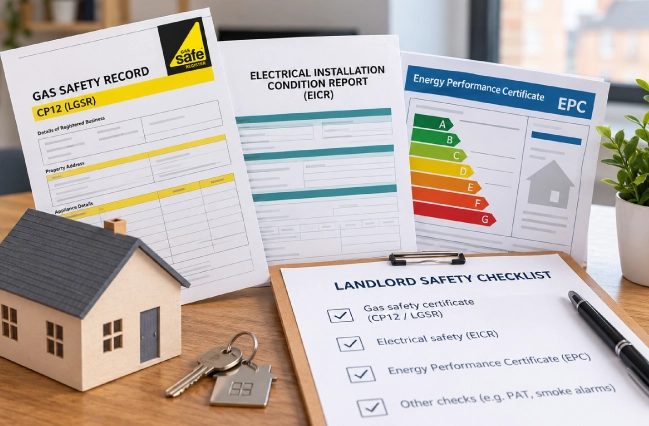
Many landlords in England start with three core records: a gas safety record where gas appliances and flues fall within the landlord’s duties, an Electrical Installation Condition Report (EICR) for the fixed electrical installation, and a valid Energy Performance Certificate (EPC) when required. The gas safety record is normally renewed every 12 months. The EICR is generally required at least every five years for covered rented properties, or sooner if the report specifies an earlier date. An EPC normally lasts 10 years, or until a newer certificate is produced for the same building. There are also checks that are not certificates but still matter, including legionella risk assessments, smoke and carbon monoxide alarms, portable appliance safety and fire risk assessments for relevant premises. This guide explains which landlord safety certificates and checks apply, how often they are needed and where to find more detail. The electrical and housing requirements in this guide focus on England. Wales, Scotland and Northern Ireland have different rules in some areas, so check the guidance applicable to your property. Serviceteam can help arrange relevant inspections and certificates across London.
England-focused guidance: most of the detailed certificate and inspection requirements on this page apply to England. Wales, Scotland and Northern Ireland have their own rules — check the section below on where rules differ before applying this to a property outside England.
- Content Guide
- » Landlord safety certificates at a glance
- » Landlord requirements in the UK: what applies where
- » Gas safety certificate for landlords (CP12 / LGSR)
- » Electrical safety: EICR, electrical inspections and PAT
- - What an EICR is
- - Is an EICR a legal requirement for landlords?
- - Understanding EICR classification codes
- - What happens if an EICR is unsatisfactory?
- - How long does an EICR last?
- - Do you need a new EICR for every new tenancy?
- - The EICR rules in brief
- - Electrical inspections and safety inspections
- - PAT testing for landlords
- - PAT testing advice: common mistakes to avoid
- - How to choose a PAT tester in London
- - PAT testing records, failed appliances and new equipment
- - Can you PAT test a TV?
- » EPC: energy performance certificate
- » Legionella risk assessment
- » Fire risk assessment
- » Commercial gas: the CP17 certificate
- » Letting agents: who holds the paperwork
- » Why compliance still matters
- » Landlord safety certificates: quick answers
- » A simple yearly rhythm for landlord certificates
- » Next steps
Landlord safety certificates at a glance
| Certificate or Check | Who Needs It | How Often |
|---|---|---|
| Gas safety record (CP12 / LGSR) | Landlords whose gas appliances and flues fall within their legal duties | At least every 12 months |
| EICR | Landlords covered by the applicable electrical safety regulations in England | At least every five years, or sooner if the report requires it |
| EPC | Landlords marketing or letting a property where an EPC is required | Valid for 10 years, or until a newer EPC is produced |
| Legionella risk assessment | Landlords must assess and control relevant risks | Review when circumstances change |
| Fire risk assessment | Responsible persons for relevant premises, including applicable shared areas | Review when necessary and when circumstances change |
| Portable appliance testing (PAT) | Private landlords must ensure supplied appliances are safe; additional duties apply to social landlords | Risk-based; no universal fixed interval for private landlords |
| CP17 commercial gas safety record | Relevant commercial premises with gas installations | Depends on the installation, equipment and applicable duties |
Smoke and carbon monoxide alarms are also a legal duty for most landlords in England. They are not a certificate, so they sit outside the table.
Not every item in a landlord compliance checklist is a mandatory certificate. Some are statutory records, some are risk assessments, and others are ways of demonstrating that equipment is being maintained safely.
Landlord requirements in the UK: what applies where
“Landlord requirements UK” is not one rule book. Housing law and electrical safety requirements differ between England, Wales, Scotland and Northern Ireland. Gas safety duties apply across Great Britain under the relevant regulations. The electrical requirements in this guide focus on England. The Electrical Safety Standards in the Private Rented Sector (England) Regulations 2020 have also been extended to the social rented sector, subject to the applicable scope and transitional arrangements. Landlords should check the current requirements for their property type rather than assuming that the private and social rented sectors have identical provisions. For certain existing social rented tenancies, the transitional rules require the first electrical installation inspection and checks of landlord-supplied electrical equipment to be completed before 1 November 2026. Social landlords should check the applicable deadlines and keep the required reports and records. “Landlord certificates” is a broad term. Some are legal requirements with fixed deadlines. Others are risk assessments, maintenance records or recommended good practice. Keeping these distinctions clear helps prevent unnecessary testing while ensuring required safety checks are not missed.
What certificates do I need as a landlord?
The documents you need depend on the property, the equipment provided and the regulations that apply to the tenancy.
For many landlords in England, the main documents to check are:
- A gas safety record where the landlord’s gas safety duties apply.
- An EICR for the fixed electrical installation where the electrical safety regulations apply.
- A valid EPC when required for marketing or letting.
- Boiler installation documentation where relevant to the installation and building regulations.
Other responsibilities may include assessing legionella risks, providing the required alarms, maintaining supplied electrical appliances safely and meeting fire safety duties for relevant premises.
A PAT test is not a universal legal certificate for every private landlord. A legionella risk assessment is about identifying and controlling relevant risks, rather than obtaining a standard certificate. A formal fire risk assessment applies to relevant premises and shared areas, not automatically to every individual rental home.
Use this list as a starting point, then check the rules for your specific property.
Gas safety certificate for landlords (CP12 / LGSR)
A landlord gas safety certificate is a record issued after a Gas Safe registered engineer checks the gas appliances and flues covered by the landlord’s duties. It is commonly called a CP12 or Landlord Gas Safety Record (LGSR). The record documents the outcome of the check and any identified safety defects or required follow-up work. It does not replace the landlord’s responsibility to maintain the relevant gas installation safely. If a property has no gas appliances or flues covered by the landlord’s duties, an annual landlord gas safety record may not be required. An all-electric property does not automatically need a CP12.
Gas safety certificate landlord obligations
The main duties come from regulation 36 of the Gas Safety (Installation and Use) Regulations 1998 — see HSE’s guide for landlords for the full obligations.
Landlords must:
- Arrange a gas safety check within 12 months of installing a relevant appliance or flue and at least every 12 months afterwards.
- Use a Gas Safe registered engineer.
- Give existing tenants a copy of the gas safety record within 28 days of the check.
- Give new tenants the latest record before they move in.
- Retain records for the required period.
The normal record-retention period is at least two years. If the landlord uses the permitted flexibility to carry out a check up to two months before its deadline while retaining the original deadline date, the record must be kept until two further checks have been completed.
Landlords are responsible for appliances they own and provide. A tenant’s own appliance is generally outside the landlord’s annual appliance-check duty, but the landlord can still have responsibilities for relevant installation pipework and flues.
Timing the gas safety check
HSE guidance allows an annual gas safety check to be carried out up to two months before its due date without changing the existing deadline date, provided the relevant conditions are met.
This flexibility helps landlords organise appointments before a certificate expires. It is still important to arrange the check early enough to allow for access difficulties or remedial work.
What happens if the gas safety check identifies a fault?
If an engineer identifies an unsafe appliance, they may turn it off or take other appropriate safety action. Follow the engineer’s instructions and arrange the required remedial work before the appliance is used again. Do not assume that receiving a gas safety record means every issue has been resolved. The record should document the inspection findings, and any necessary follow-up action must be addressed.
What if a tenant refuses access for a gas safety check?
Do not force entry. Explain the legal requirement to the tenant, offer reasonable appointment options and retain a record of correspondence and access attempts. HSE guidance recommends documenting reasonable efforts to complete the inspection. Whether the steps taken are sufficient depends on the circumstances, so keep a clear record of the actions taken to arrange access. Read our guide to ensuring gas safety with a CP12 certificate. Need a certificate? Arrange a CP12 gas safety certificate with a Gas Safe registered engineer.
Electrical safety: EICR, electrical inspections and PAT

Electrical safety involves the fixed wiring, the electrical equipment supplied with a property and the condition of the installation over time.
An EICR assesses the fixed electrical installation. Regular electrical inspections help identify deterioration and potential hazards. Portable appliance testing (PAT) concerns electrical equipment that can be plugged in and moved.
The legal requirements depend on the landlord and property type. In England, fixed-installation inspection requirements apply to covered private and social rented properties. PAT testing does not have one universal statutory interval for private landlords, although general safety duties still apply and social landlords have additional equipment-check requirements.
What is an EICR?
An EICR is an Electrical Installation Condition Report. A qualified person inspects and tests the fixed electrical installation to assess its condition and identify potential safety problems. The inspection may cover the consumer unit, wiring, sockets, switches, light fittings, earthing, bonding and relevant protective devices. Permanently connected equipment, such as electric showers and extractor fans, may also form part of the installation being assessed. The report records the findings and gives an overall outcome of satisfactory or unsatisfactory. Observations use classification codes to identify problems and recommended action. An EICR is different from an Electrical Installation Certificate (EIC). An EIC is associated with new electrical installation work, such as a new installation or rewire. An EICR assesses the condition of an existing installation. The documents should not be treated as interchangeable.
Is an EICR a legal requirement for landlords?
Yes. In England, landlords covered by the electrical safety regulations must ensure their rented property’s fixed electrical installation is inspected and tested by a qualified person at least every five years, or sooner where the report specifies an earlier date. The landlord must obtain the report and provide copies to tenants and the local authority when required. The regulations include specific requirements for remedial work, record keeping and supplying documents. The rules cover most relevant private and social rented properties in England, but there are exceptions. These include certain shared accommodation with the landlord or their family, long leases, student halls, hostels, refuges and specified healthcare accommodation. Check the current regulations if your property falls into a special category. The English requirements should not automatically be applied to properties in Wales, Scotland or Northern Ireland.
Understanding EICR classification codes
The main codes you may see on an EICR are:
- C1 — Danger present: a risk of injury has been identified. The inspector may make the immediate hazard safe before leaving.
- C2 — Potentially dangerous: remedial work is required.
- C3 — Improvement recommended: an improvement is advised, but C3 alone does not make the report unsatisfactory.
- FI — Further investigation required: further investigation is needed without delay.
C1 and C2 observations make the report unsatisfactory. FI requires the landlord to arrange the necessary investigation. The electrician should explain the findings and what action is required.
What happens if an EICR is unsatisfactory?
An unsatisfactory EICR means the inspection has identified electrical safety issues that need remedial work or further investigation. The report should explain what has been found and what needs to happen next. Common findings can include damaged sockets or switches, defective extractor fans, faulty light fittings, overloaded circuits, or problems with earthing and bonding. The actual findings depend on the condition of the installation. For landlords covered by the English regulations, required remedial or investigative work must be completed within 28 days, or sooner if the report specifies a shorter period. Do not treat this as permission to leave an immediate danger unaddressed. Follow the report’s safety instructions and arrange urgent action where necessary. Once the work is complete, obtain written confirmation from the qualified person. Provide the required documentation to the tenant and local authority within the applicable deadline. Depending on the work, acceptable evidence may include a satisfactory EICR, an Electrical Installation Certificate or a Minor Electrical Installation Works Certificate. Keep the original report and evidence of completed work. If further investigation identifies additional work, follow the next steps set out by the qualified person and applicable regulations.
How long does an EICR last?
For covered rented properties in England, electrical installations must generally be inspected and tested at least every five years, or sooner if the report specifies an earlier date. The date on the report matters. Do not assume that every EICR automatically lasts five years, and arrange the next inspection before the stated deadline. A new tenancy does not automatically mean a new inspection is required when a qualifying, in-date report already exists and no further remedial or investigative work is outstanding. The landlord must provide the existing report to the new tenant before occupation. Check the current regulations and report details where the circumstances are unclear. A new installation or rewire may come with an Electrical Installation Certificate. Where the applicable requirements are met, this can affect when the next periodic inspection is due. If you need an EICR in London, see our EICR service page.
Do you need a new EICR for every new tenancy?
No, not automatically. Where a qualifying report is still in date and no outstanding remedial or investigative work requires action, a further inspection is not automatically needed simply because a new tenant moves in. The landlord must provide the most recent report to the new tenant before occupation. A visual check before a new tenancy is also sensible to identify obvious damage or changes since the last inspection. If there are signs of damage, deterioration or unsafe electrical work, arrange a suitable inspection rather than relying solely on the existing report. Read our separate guide to whether you need a new EICR for every new tenancy.
The EICR rules in brief
Landlords covered by the electrical safety regulations in England must:
- Arrange inspection and testing by a qualified person at least every five years, or sooner if the report requires it.
- Obtain the report and retain the relevant records.
- Give existing tenants a copy within 28 days of the inspection and test.
- Give new tenants the most recent report before occupation.
- Give prospective tenants a copy within 28 days of a request.
- Provide the report to the local authority within seven days of a written request.
- Complete required remedial or investigative work within 28 days, or sooner if the report specifies a shorter period.
- Obtain written confirmation of completed work and provide the required documents to tenants and the local authority within the applicable deadline.
The regulations contain exceptions for certain types of accommodation. If a landlord fails to meet specified duties, the local authority may take enforcement action and may impose a financial penalty of up to £40,000 under the current guidance.
The landlord remains responsible for meeting the applicable requirements, even if a letting agent arranges the inspection.
Electrical inspections and safety inspections
Electrical inspections and electrical safety inspections usually refer to checking a property’s electrical installation. For landlords in England, a periodic inspection by a qualified person produces an EICR that records the installation’s condition and identifies any required remedial work or further investigation. An inspection may examine the consumer unit, wiring, sockets, switches, earthing and bonding, and relevant protective devices such as RCDs. It can identify deterioration, defective work, overloaded circuits and potential shock or fire hazards. Domestic electrical testing helps identify problems with fixed wiring and electrical installations before they become more serious. There are times when you should not wait for the next scheduled inspection. Repeatedly tripping circuits, flickering lights, burning smells, hot sockets or visible electrical damage need prompt attention. If you suspect immediate danger, stop using the affected equipment or circuit if it is safe to do so and seek urgent help from a qualified professional. An electrical safety inspector should be competent to carry out periodic inspection and testing. Check their qualifications, relevant experience and credentials before booking. The title alone is not proof of competence. Regular inspections are not just about paperwork. They can identify problems before they become more serious and help landlords meet their responsibility to keep rented properties safe.
PAT testing for landlords
PAT stands for portable appliance testing. It concerns electrical equipment such as kettles, toasters, lamps, microwaves and other plug-in appliances. It is not the same as an EICR, which assesses the fixed electrical installation. For private landlords in England, there is no general statutory requirement to PAT test every appliance at a fixed interval. However, landlords must ensure that electrical equipment they supply is safe. HMO licensing conditions or other applicable requirements may also affect what checks are needed. Social landlords in England must arrange checks of electrical equipment they supply under covered tenancies by a qualified person at least every five years, or sooner where the record requires. Transitional deadlines apply to some existing tenancies — for tenancies granted before 1 December 2025, the first check is generally required by 1 November 2026. These requirements should not be confused with the general position for private landlords. The appropriate inspection and testing arrangements depend on the equipment, how it is used and the risks involved. Do not treat annual PAT testing as a universal legal deadline for every private landlord. For more detail, see:
- PAT testing for landlords: is it mandatory in London?
- Portable appliance testing
- How often should PAT testing be done?
- PAT testing vs electrical inspection
PAT testing advice: common mistakes to avoid
A PAT check can include a visual inspection and, where appropriate, electrical tests. Common mistakes include overlooking damaged plugs or cables, missing accessible earthed parts, using unsuitable test methods or interpreting results against the wrong criteria. A pass label does not guarantee that an appliance will remain safe indefinitely. If a plug, lead or appliance looks damaged, stop using it and arrange an appropriate check.
How to choose a PAT tester in London
For PAT testing in London, check that the person is competent for the equipment and tests involved. Ask about relevant training and experience, the equipment used, how failed appliances are reported, and whether the contractor has suitable public liability insurance. Confirm the scope, appliance count, access arrangements and price before booking. A formal electrician qualification is not a universal requirement for every PAT inspection, but combined inspection and testing requires suitable competence.
PAT testing records, failed appliances and new equipment
For private landlords, a simple appliance register can help track each item, its location, inspection date, results and any repair or replacement. HSE does not generally require PAT labels or records under the Electricity at Work Regulations, but keeping them is useful evidence of a maintenance system. Separate statutory record duties apply to social landlords under the electrical safety regulations. If an appliance fails a safety check, take it out of use and arrange suitable repair or replacement before it is used again. New equipment should normally arrive safe and does not automatically need a formal PAT test before first use; a visual check for transport damage is sensible. For social landlords in England, the statutory equipment-check duties also apply to new equipment supplied under a tenancy.
Can you PAT test a TV?
A plug-in television may be included in an appliance safety inspection. The person checking it should examine the plug, lead, casing and visible damage, then decide which further tests are suitable for that particular TV. Do not attempt electrical testing using generic online instructions or assume that every appliance needs the same test.
EPC: energy performance certificate
An Energy Performance Certificate (EPC) rates a property from A to G for energy efficiency. It provides information about the property’s energy performance and recommendations for potential improvements. You generally need a valid EPC when marketing a property to let, subject to applicable exemptions. An EPC normally lasts 10 years, or until a newer EPC is produced for the same building. It can be reused for a new tenancy while it remains valid, provided the property continues to meet the applicable requirements. In England, a property covered by the Minimum Energy Efficiency Standards generally cannot be let if its EPC rating is below E unless a valid exemption applies. Check current government guidance before planning upgrades or relying on a future compliance date.
Do I need a new EPC after a home extension?
Not automatically. An extension, loft conversion or energy-efficiency improvement does not, by itself, automatically cancel an existing EPC. However, significant changes can affect how accurately the existing certificate reflects the property. An extension, new living space, improved insulation, replacement windows or changes to heating and hot water systems may affect its assessed energy performance. If you plan to sell or rent out the property, check whether the existing EPC is still valid and whether it accurately represents the building. A new assessment may be appropriate after substantial alterations, particularly where the property has changed significantly. Whether a new EPC is required depends on the applicable rules and circumstances, not simply on the fact that building work has taken place. An EPC assessment considers factors such as the property’s construction, insulation, glazing, heating, hot water and lighting. It provides an energy-efficiency rating and recommendations for potential improvements. Those recommendations do not, by themselves, create a legal requirement to carry out every suggested measure.
For more detail, see:
Legionella risk assessment
Legionella is a bacteria that grows in water systems when conditions allow it to multiply. If someone inhales contaminated water droplets or mist, they can develop Legionnaires’ disease, a serious form of pneumonia. Older people and people with weakened immune systems or certain underlying health conditions are more vulnerable to severe illness. In an ordinary rented home the risk is usually low, but landlords still have a duty under health and safety law to assess and control it. A Legionella certificate is not generally a legal requirement for landlords. HSE is clear that the law does not require landlords to obtain a Legionella test certificate — that includes Legionella testing and Legionella monitoring. Routine microbiological sampling is generally unnecessary in ordinary domestic systems; what matters is assessing the risk and putting proportionate controls in place, not lab-testing the water or holding a certificate.
What does a Legionella risk assessment involve?
For a typical home with simple plumbing, the assessment is a short, practical exercise. It looks at how hot and cold water is supplied, stored and distributed; whether outlets are used regularly or sit idle; temperature controls on tanks, pipework and showers; and dead legs — sections of pipework where water can sit stagnant and let bacteria grow. Flush the system before a let, especially after a void period. Keep cold water tanks covered with a tight-fitting lid. Keep a record of what you checked and any action taken. Larger buildings and more complex water systems — stored water, multiple risers, infrequently used outlets — usually need a more detailed written risk assessment from a competent person. HMOs often fall into this category simply because the plumbing is more complex, but it’s the system’s complexity and risk, not the HMO label itself, that decides whether specialist input is needed; a simple HMO with straightforward plumbing may not need more than the basic checks above.
How often should a Legionella risk assessment be reviewed?
Review periodically and whenever changes to the water system, property use or risk controls make reassessment necessary. There is no universal statutory annual or two-year renewal interval. In practice that means checking in after alterations to the hot or cold water system, a change in how the property or system is used, a prolonged period when outlets have not been used, a change of managing agent or responsible person, evidence that your existing controls are no longer working, or a suspected or confirmed case of Legionnaires’ disease linked to the system.
Managing the risk day to day
Control measures should match the system and the findings of the assessment. In practice that usually means flushing before letting, keeping tanks covered, maintaining sensible hot and cold water temperatures, removing redundant pipework that creates stagnant sections, and cleaning showerheads periodically. Make sure tenants know how to report a problem, such as hot water that no longer heats properly.
If you want a Legionella risk assessment done in London, see our Legionella risk assessment service.
Fire risk assessment

A fire risk assessment is a legal duty under the Regulatory Reform (Fire Safety) Order 2005 for relevant premises, including the shared parts of multi-occupied residential buildings — blocks of flats and HMOs. The responsible person must carry it out and review it when necessary. It is not a universal certificate required for every individual rental home; whether a formal assessment applies depends on the premises and the fire safety legislation in play.
Who is responsible for a fire risk assessment?
The responsible person is usually the landlord, freeholder or managing agent with control of the premises, under the Fire Safety Order. In England, the Fire Safety Act 2021 clarified that the assessment must also cover the building’s structure and external walls, including flat entrance doors — not just the obvious communal areas like hallways, stairwells and fire doors. The responsible person stays accountable for the assessment being suitable and the fire safety measures being maintained, even when a contractor carries out the work, and must keep a full record of the assessment and fire safety arrangements.
What does a fire risk assessment cover?
A suitable assessment looks at fire hazards (ignition sources, combustible materials), the people who might be at risk (residents, visitors, anyone who may need help evacuating), the likelihood and consequences of fire, and the fire precautions in place — escape routes, fire doors, alarms and emergency arrangements. For blocks of flats, this extends to the relevant common parts and building elements, including external walls and flat entrance doors, within the Fire Safety Order’s scope.
When should a fire risk assessment be reviewed?
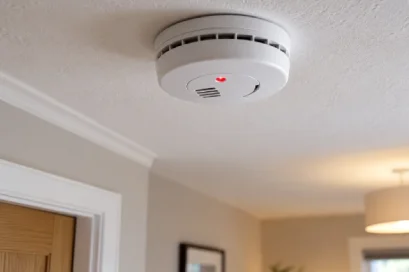
Review it regularly, and sooner if there’s reason to think it’s no longer valid or something significant has changed — building alterations, a change in how the premises are used, changes to fire precautions, or a fire incident. There’s no blanket statutory requirement to carry out a brand-new assessment every year; an annual review is recognised good practice for small, simple premises, but the right frequency depends on the building and its risks. Separate from this, landlords in England have duties concerning smoke and carbon monoxide alarms. For many private rented homes in England, a smoke alarm is required on every storey used as living accommodation, and a carbon monoxide alarm is required in a room used as living accommodation containing a fixed combustion appliance, except a gas cooker. Alarms must be checked at the start of a new tenancy, and a reported fault repaired or replaced as soon as reasonably practicable.
If you let an HMO or manage shared areas in London, see our fire risk assessment service.
Commercial gas: the CP17 certificate
CP17 is commonly used as a commercial gas installation safety record for premises such as shops, restaurants and offices. A Gas Safe registered engineer carries out the relevant inspection and issues the record. The appropriate inspection and maintenance frequency depends on the installation, equipment, legal duties, manufacturer guidance and risk. Annual inspection is common, and some leases, insurers or maintenance contracts may require it. Do not confuse a commercial gas safety record with the CP12 for a rented home. If you let a flat above a shop, the flat may need its own annual landlord gas safety check. Read our guide to the CP17 commercial gas installation safety certificate, or book one.
Letting agents: who holds the paperwork
If you use a letting agent, the legal duty generally remains with you as the landlord. Your agent may arrange inspections, chase access and store records, but you should make sure the required work is completed and the documents are supplied on time. Agree in writing who books each inspection, who retains the records and who sends copies to tenants. Keep one file per property and organise it by certificate type. Renewals can be missed during a change of tenant, a change of agent or a busy management period. Check the dates yourself regularly. If you manage several properties, keep a single compliance schedule showing each property, certificate and next due date.
Why compliance still matters
Landlords must keep their properties safe and meet the legal requirements that apply to their accommodation. Missing inspections, ignoring remedial work or failing to provide required records can lead to enforcement action and financial penalties. A certificate alone does not make an unsafe property safe. Take action on reported faults, retain evidence of completed work and give tenants the documents they are entitled to receive. Keep your records in date, give tenants the required information within the applicable deadlines and retain proof that you have done so.
Landlord safety certificates: quick answers
What certificates do landlords need?The requirements depend on the property and the landlord’s responsibilities. Common documents include a gas safety record, an EICR and a valid EPC where required. Other duties may include legionella risk assessments, alarm provision, safe electrical appliances and fire safety assessments for relevant premises.
Is a gas safety certificate a legal requirement for landlords?Yes, where the landlord’s duties cover gas appliances or flues. The relevant appliances and flues must be checked by a Gas Safe registered engineer at least every 12 months.
What is an LGSR certificate?LGSR stands for Landlord Gas Safety Record. It documents the results of the relevant gas safety checks and is commonly referred to as a landlord gas safety certificate or CP12.
How long does a gas safety record last?The gas safety check must normally be repeated at least every 12 months. Landlords must give existing tenants the record within 28 days of the check and provide the latest record to new tenants before they move in.
Do I need a new EICR for every new tenant?Not automatically, if the existing report is still in date and no remedial work is outstanding — see the EICR section above for the detail.
How long does an EICR certificate last?Up to five years for covered rented properties in England, or sooner if the report specifies an earlier date.
Is an EICR a legal requirement for landlords?Yes, for landlords covered by the applicable electrical safety regulations in England — see the EICR section above for who’s covered and the exceptions.
What happens if an EICR fails?Required work must be completed within 28 days, or sooner if the report specifies a shorter period, with written confirmation once it’s done — see “What happens if an EICR is unsatisfactory?” above for the full process.
What is the difference between an EIC and an EICR?An Electrical Installation Certificate (EIC) is associated with new electrical installation work. An Electrical Installation Condition Report (EICR) assesses the condition of an existing installation. They serve different purposes.
Is PAT testing a legal requirement for landlords?Private landlords in England do not have a general statutory requirement to PAT test every appliance at a fixed interval. They must still ensure supplied equipment is safe. Social landlords have additional requirements for electrical equipment supplied with a tenancy.
Does PAT testing affect liability insurance?Ask your insurer what your policy requires. Some policies or contracts may specify electrical safety checks, but there is no universal rule that an insurance claim is automatically invalid without a PAT certificate. Keep evidence of appropriate maintenance and any remedial action.
Do new appliances need PAT testing?Not automatically. New equipment should be supplied in a safe condition; a visual check for damage is sensible. Social landlords must also meet the statutory equipment-check requirements that apply to their tenancies.
Do I need a new EPC for every tenancy?No. An EPC generally lasts 10 years, or until a newer EPC is produced for the same building. It can be reused while valid, provided the property continues to meet the applicable requirements.
Do I need a new EPC after an extension?Not automatically. An extension or energy-efficiency improvement does not, by itself, invalidate an existing EPC. Check whether the certificate is still valid and whether it accurately reflects the property before marketing it.
What is a fire safety certificate for landlords?There is no universal fire safety certificate required for every rental property. Landlords and responsible persons must meet the fire safety duties that apply to their property, which may include a formal fire risk assessment, appropriate alarms and safe escape routes.
Who is responsible for arranging landlord safety certificates?The landlord remains responsible for meeting the applicable legal duties, even when a letting agent arranges inspections. Agree who manages bookings and paperwork, and check the records yourself.
A simple yearly rhythm for landlord certificates
If you manage more than one property, a compliance calendar helps prevent missed deadlines.
- Gas safety record: every 12 months, using the permitted early-check window where applicable.
- EICR: at least every five years, or the earlier date specified in the report.
- EPC: normally valid for 10 years, or until a newer EPC is produced. Check validity before marketing the property.
- Smoke and carbon monoxide alarms: check at the start of each new tenancy and respond to faults as required.
- Legionella: review the risk assessment when circumstances change.
- Fire risk assessment: review when necessary and as part of ongoing management of relevant premises and shared areas.
- Portable electrical equipment: arrange appropriate checks based on the equipment, risks and duties applicable to the landlord.
Keep copies of the records, give tenants the documents they are entitled to receive and retain proof that you have met the relevant deadlines.
Next steps
Start with the inspections and certificates that apply to your property. Book a CP12 gas safety certificate if your landlord gas safety duties apply. Book an EICR in London if you need an inspection, your report is due for renewal or the existing report identifies work that needs attention. Then check the remaining requirements for your property, including its EPC, relevant alarm duties, water-system risks and any fire safety obligations.