If your radiators aren't heating properly, the cause is often one of five things: trapped air, sludge inside the system, a valve that's shut, seized or set wrong, an imbalanced system, or a fault with the boiler itself rather than the radiator. Working out which one you've got usually points you to a straightforward fix.
A quick way to narrow it down before you read further: cold at the top only may point to trapped air. Cold at the bottom only may point to sludge. Cold all over on one radiator often means a closed or faulty valve. Cold all over on every radiator may point to the boiler or the pump rather than the radiators themselves. Noisy pipes often mean trapped air. Persistent cold spots that come back after bleeding can mean sludge that a bleed key can't shift on its own.
This guide covers the whole cluster: how to operate your radiators and valves, how your heating system is set up, what's causing cold spots or noises, and when a quick fix isn't enough and you need a powerflush or a new radiator. We cover London homes specifically, since that's where most of the properties we work on sit, from converted flats on old gravity-fed systems to newer S-Plan installs with combi boilers.
- Content Guide
- » Turning your radiators on, off, bleeding and balancing them
- » Understanding your heating system setup
- » Radiator valves, TRVs and smart controls
- » Sludge, cold spots and discoloured water
- » Leaks, noises and physical faults
- » When the problem is your boiler, not the radiator
- » Getting the most efficient heat from your system
- » Powerflush or replacement: which one do you need?
- » Get your heating sorted with Serviceteam
Turning your radiators on, off, bleeding and balancing them

Before troubleshooting anything, it helps to know the basics are set up right. If you're not sure how to turn a radiator on in the first place, we've got a dedicated step-by-step for every radiator type — panel, column, towel and electric — in our guide on how to turn a radiator on. It also covers the two-knob setup you'll find in most London homes, where a manual valve and a lockshield valve sit on opposite sides of the radiator.
Once it's on, you might need to turn a radiator off off for a specific room, bleed a radiator to clear trapped air causing cold spots, or balance a radiator so heat is distributed evenly across your whole system rather than pooling in the radiators nearest the boiler. Balancing is the one most people skip, but it's often the difference between one room roasting and another staying cold even though every valve is technically open.
These three jobs solve the majority of radiator heating complaints on their own, before you need to think about sludge or a professional visit. They cost nothing beyond ten minutes and a radiator key, so they're always worth trying first.
Understanding your heating system setup
Not every central heating system works the same way, and knowing which one you've got makes troubleshooting faster, because a fix that works on one setup can be irrelevant on another.
Most London homes run an S-Plan or Y-Plan system, which controls how your boiler, cylinder and radiators are wired together through motorised valves and a programmer. These systems behave differently when something goes wrong — a stuck motorised valve can mimic a boiler fault, for instance. See our breakdown of S-Plan vs Y-Plan central heating systems if you're not sure which you have, or you're planning an upgrade and want to know what you're changing.
Some older or off-grid properties use warm air heating systems instead of wet radiators, circulating heated air through ducts rather than water through pipes. None of the radiator troubleshooting in this guide applies to those systems, since there's no water, no valves and no sludge involved — the problems and fixes are completely different. If you've got a Johnson and Starley unit specifically, we've got a dedicated guide to Johnson and Starley warm air heating and how to keep it running. If central heating troubleshooting hasn't fixed a warm air heater in your home, it's worth checking that guide instead of this one.
Radiator valves, TRVs and smart controls
Every radiator has at least one valve controlling how much hot water flows through it, and getting these right solves a surprising number of cold room problems before you need to call anyone.
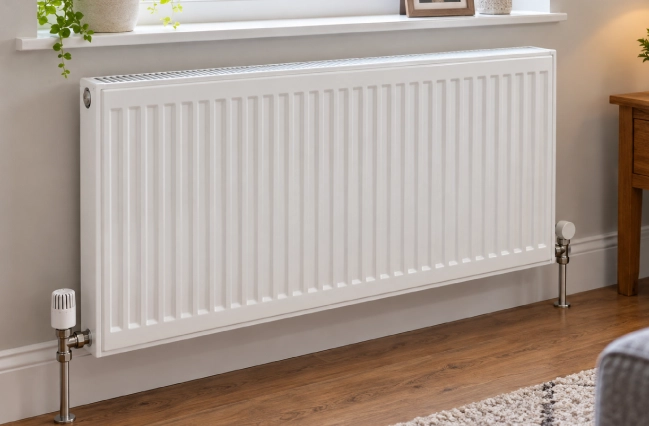
A thermostatic radiator valve, or TRV, is the numbered dial you'll usually find on one side of the radiator. It's what lets you set a different temperature for each room rather than heating the whole house to one setting. TRVs adjust water flow automatically based on the room's temperature, so turning the dial up gives more heat and down gives less — most run on a scale from 0 to 5, with 3 as a reasonable everyday setting for a living room. If yours seems stuck, always feels maxed out no matter the setting, or the room temperature doesn't match the number you've set, the valve pin itself may have seized and need replacing rather than adjusting.
On the other side, you'll usually find a lockshield valve. This one's not for day-to-day adjusting — it's set once, usually by an engineer, to balance water flow across the system. If you've never had your radiators balanced, or one room heats up quickly while another stays lukewarm no matter how long the heating's on, our guide to what a balance valve does explains what it's for and when to leave it alone rather than fiddling and making things worse.
Beyond individual valves, smart thermostats and smart radiator valves let you control heating room by room from your phone, often cutting energy use by only heating rooms you're actually using rather than the whole property on one schedule. Whether that's worth it for your home depends on your setup, how many rooms you routinely leave empty, and how much you're currently overheating them to compensate — we've weighed the costs and savings up properly in our guide to smart heating controllers. Whatever thermostat you're running, setting it correctly matters just as much as which one you buy, so see our guide on the ideal thermostat temperature for a UK home if you're not sure where to set it for comfort without wasting money.
Sludge, cold spots and discoloured water

Cold spots and sludge go together more often than people expect. If a radiator is hot at the top and cold at the bottom, that's usually not trapped air — air rises, so it collects at the top, not the bottom. A cold bottom means sludge sitting there instead, blocking hot water from circulating through the lower section of the radiator. Our guide on radiator cold at the bottom walks through how to spot the difference and what to do about it.
If only one radiator in the house is affected, start with our troubleshooting guide for one radiator not working before assuming the whole system needs attention. A single cold radiator is often isolated to that radiator's own valves rather than a system-wide sludge problem, and it's a much smaller job to sort.
You can shift a small amount of sludge yourself, and our guide on how to remove sludge from a radiator covers the DIY version using a radiator key and a bit of patience. But if you're also seeing discoloured water in your heating system when you bleed a radiator — anything from rusty orange to black — that's a sign the sludge has spread beyond one radiator and into the wider pipework and boiler. DIY bleeding won't fix that, and it can come straight back within weeks. At that point you're looking at a professional powerflush rather than a home fix, which is where our central heating powerflush service comes in, since it clears the whole system rather than just one radiator.
Leaks, noises and physical faults
Some radiator problems aren't about heat distribution at all — they're mechanical. A banging noise from a radiator often points to trapped air or, on older systems, limescale build-up inside the pipework causing kettling, and it's usually fixable without calling anyone out. A dripping or damp valve is a different matter, so see our guide to fix a radiator leak for what's safe to tighten yourself and when to shut off the system at the isolation valve and get someone in.
Covering a radiator changes how it heats a room too. If you're boxing one in or fitting a decorative cover, it's worth reading do radiator covers block heat first, since the wrong cover design can trap heat against the wall instead of pushing it into the room, undoing whatever else you've done to get the system running efficiently.
If a radiator is leaking badly, corroded through, or simply past its working life, patching it isn't always worth it. Repeated repairs on an old radiator often cost more over a year than one replacement. That's when it makes more sense to look at radiator replacement rather than repeated repairs, particularly on older cast iron or steel panel radiators that are more prone to internal corrosion over time and harder to source matching parts for.
When the problem is your boiler, not the radiator
Sometimes the radiator itself is fine and the fault sits upstream at the boiler. If your boiler keeps turning off during a heating cycle, or won't stay lit, that's rarely a radiator issue — it usually points to pressure, a faulty sensor, or the boiler shutting down as a safety response to something else in the system. Similarly, if every radiator in the house is lukewarm at once rather than just one, check whether your boiler circulator pump is working, since that pump is what actually pushes hot water round the system, and a failing pump affects every radiator equally rather than just one.
Trapped air isn't always limited to a single radiator either — sometimes it sits in the system itself near the boiler, in a spot no bleed key can reach. If bleeding individual radiators hasn't fixed persistent cold spots across the house, clearing a boiler airlock is the next step. And if you're getting repeated pressure loss, discoloured water, or a boiler that seems to be working harder than it should to hit temperature, boiler corrosion inside the heat exchanger or pipework could be the underlying cause — something a powerflush and a magnetic filter go a long way to preventing going forward.
Getting the most efficient heat from your system

A heating system that's balanced, bled and sludge-free is naturally the most efficient way to heat a home, since you're not wasting energy fighting cold spots or overheating rooms to compensate for ones that won't warm up. It's worth ruling this out before spending money elsewhere.
Compare that to something like halogen heaters, a common quick fix people reach for when one room's cold, and the disadvantages of halogen heaters become obvious pretty fast: they heat a small area at a high running cost per hour and do nothing for the rest of the house, so you end up paying twice — once for the central heating that isn't working properly, and once for the plug-in heater plugging the gap. A properly working central heating system, with TRVs set sensibly room by room and the odd smart control where it's useful, gives you energy efficient heating across the whole property instead of patching one room at a time with expensive stopgaps.
Powerflush or replacement: which one do you need?
Not every radiator problem needs the same fix, so it's worth being clear on which route applies to you before you book anything.
If the issue is sludge, discoloured water, cold spots that come back after bleeding, or a boiler working harder than it should, that's a system-wide circulation problem, and a central heating powerflush may be appropriate after assessment. It's designed to clear the whole system in one visit rather than treating symptoms in one radiator at a time, and it can help protect the boiler from the same sludge causing a more expensive breakdown later. Our full powerflush guide and our page on powerflushing in London both go into more detail on the process, timing and what to expect on the day if you're weighing it up.
If instead a specific radiator is corroded, leaking from the body rather than a valve, or simply too old and inefficient to repair economically, that's a replacement job rather than a system flush, so see radiator replacement for pricing and next steps. It's common to need both — a powerflush for the system and a replacement for one radiator that's beyond saving — and we can quote for either or both at the same visit.
Get your heating sorted with Serviceteam
Most radiator problems in this guide are things you can check or fix yourself in ten minutes with a bleed key and a bit of know-how. When they're not — when sludge keeps coming back, a valve won't budge, or the boiler's the real problem — that's when it's worth bringing in a Serviceteam engineer rather than working through the list again.
We handle everything from a central heating powerflush to full radiator replacement across London, alongside the boiler and valve repairs covered throughout this guide. Get in touch to book an engineer, or ask us a question first if you're still not sure which fix you need — it's better to check than to book the wrong job.