Most blocked toilets and slow drains we see in London come down to one of four things: a soft blockage in the trap, a build-up further down the waste pipe, a worn part inside the cistern, or a macerator that has stopped cutting. The trick is working out which one you’ve got before you start pouring things down the pan.
This page is the starting point for everything we’ve written on toilets, drains, blockages and Saniflo systems. Work through the section that matches your symptom, then follow the link to the detailed guide.
If water is rising in the pan right now, stop flushing. Every flush adds more water to a pipe that cannot take it.
- Content Guide
- » Start here: match your symptom
- » Blocked toilets
- » Toilet cistern problems: leaks, replacement and repair
- » Other toilet repairs
- » Blocked drains and slow-draining sinks
- » Drain smells
- » Bath and shower wastes
- » Saniflo and macerator problems
- » Pipework and water quality
- » What you can fix yourself, and what needs a plumber
- » Next step: get it cleared today
Start here: match your symptom
Quick triage before you pick a section.
- Water rises then drains slowly — soft blockage in the toilet trap or the branch pipe.
- Water doesn’t move at all — solid blockage, or the soil pipe is blocked further down.
- Toilet flushes weakly but drains fine — cistern problem, not a blockage.
- Sink or bath drains slowly and gurgles — partial blockage, or a venting issue.
- Several fittings backing up at once — the problem is in the shared drain outside, not in the room.
- Saniflo humming, buzzing or running on — macerator fault. Don’t keep flushing it.
That last one matters. A macerator is a pump with a blade in it. If it’s straining, running it again makes the damage worse.
Blocked toilets
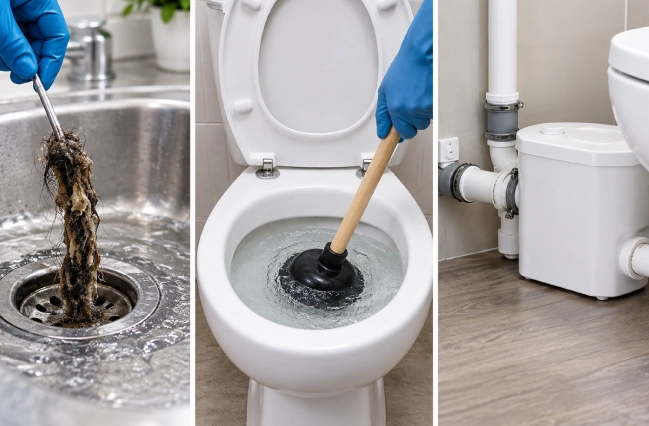
A toilet blocks in one of three places: the trap in the base of the pan, the short branch pipe behind the wall, or the soil stack. If it’s a simple trap blockage, you may be able to clear it yourself. Start with our step-by-step guide on how to unblock a toilet. It covers the plunger technique properly, which most people get wrong. You want a slow push and a sharp pull. The pull is what shifts the blockage. Pushing hard just packs it tighter.
Before you start, get the right kit together. Our rundown of the tools for unblocking a toilet covers what’s actually worth owning: a proper flanged plunger, a toilet auger, gloves and a bucket. A sink plunger won’t seal against a toilet pan. If the pan empties but never quite clears, the problem may not be a blockage at all. Read why is my toilet not flushing properly to work out whether you’re dealing with a partial blockage, a low water level in the cistern, or blocked rim jets. Limescale in the rim jets is very common in London and gets misdiagnosed as a blockage constantly. What not to do: don’t use caustic drain crystals in a toilet. If they don’t clear it, you now have a blocked toilet full of caustic liquid, and any plumber who attends has to deal with that before they can start.
Toilet cistern problems: leaks, replacement and repair
This section covers the cistern themes absorbed into this hub — cistern replacement, cisterns leaking underneath, and general toilet repair. A cistern leaking underneath is often linked to one of three seals: the doughnut washer between the cistern and the pan, the backnut on the flush valve, or the inlet valve tail washer. Dry the area, put kitchen roll under each point, and check which one wets first. That tells you the part to replace. The doughnut washer is the most common culprit on older close-coupled suites, and it’s a cheap part. The cistern has to come off the pan to change it, which is the bit that puts people off.
Full cistern replacement is worth it when the cistern itself is cracked, when the ceramic is crazed at the fixing points, or when you can’t get parts for a discontinued flush mechanism. Otherwise, replacing the internals is cheaper and quicker. Our ultimate guide to toilet repair walks through the whole cistern assembly and what each part does. For the flush mechanism itself, we’ve got a dedicated guide on how to fix a toilet siphon — the diaphragm is the part that perishes, and it’s a few pounds to replace. That guide covers the diagnosis and the replacement in full, so we won’t repeat it here.
If the cistern never stops filling, read why is my toilet water running. A running toilet wastes a genuinely large amount of water, and on a metered supply in London it shows up on the bill fast. And if the handle has gone floppy or the flush needs two attempts, the fix is usually a linkage or a nut, not a new mechanism. See how to fix a loose toilet handle.
Other toilet repairs
Not everything wrong with a toilet is a blockage or a cistern fault. Water pooling around the base is a separate problem with its own causes. Our guide on why is my toilet leaking from the base covers the pan connector, the floor seal and the failure modes that look identical but need different fixes. Get this one diagnosed properly. A leaking pan connector will rot a floor quietly for months. For the smaller jobs, our collection of simple DIY tips to fix toilets covers the quick wins: adjusting fill levels, freeing a sticking flush, sorting a slow refill.
London’s hard water means limescale builds up fast, inside the rim and around the waterline. It restricts the flush and makes the pan look permanently dirty. Our guide on how to remove how to remove limescale from a toilet covers what works on heavy scale and what just wastes an afternoon. Seats wear out, hinges corrode, and a loose seat cracks the ceramic underneath it over time. If yours is moving, read how often should I replace a toilet seat. Adding a bidet attachment is one of the more common toilet upgrades we get asked about. It’s a straightforward job if the cold feed and the isolation valve are accessible. See how to attach a bidet to a toilet for the connection points and what to check first.
Blocked drains and slow-draining sinks

Sinks and drains block for different reasons than toilets do. Kitchen sinks block with fat and food. Bathroom sinks and showers block with hair and soap scum. Outside drains block with leaves, silt and root ingress. The general method — plunger, then trap, then rods — is in our guide on how to clear a blocked drain. Start there if you’re not sure what you’re dealing with. For kitchens specifically, read the top 5 causes of blocked kitchen sink drains in London. Cooking fat is the big one. It goes down warm and liquid, then sets solid in the cold pipe run under the floor. Cooling and binning it is the single best habit change for a kitchen sink.
Showers are often affected by hair and soap residue. Our guide on how to unblock a shower drain covers getting the trap out, clearing it, and refitting it without cracking the tray. A sink that drains but gurgles is telling you something different usually a partial blockage or an air path problem in the waste. See how do you fix a gurgling sink. Gurgling is worth acting on early because it’s the stage before a full blockage. If the problem is outside a gully overflowing, or a chamber filling up read how to unblock a drain pipe outside. Lift the inspection chamber cover nearest the property first. If it’s full, the blockage is downstream of it. If it’s empty, the blockage is between the house and that chamber. That single check saves a lot of guessing. One thing to know about London terraces: if several properties back onto a shared drain and everyone is backing up at once, that’s a shared or public sewer issue, and it may be Thames Water’s responsibility rather than yours.
Drain smells
A drain that smells but drains fine usually has a dry or damaged trap, not a blockage. The water seal in the U-bend has evaporated, and sewer gas is coming back up. Running the tap for thirty seconds refills it. If it’s not that, the smell is coming from a build-up of biofilm inside the pipe, and it needs cleaning out rather than clearing. Our guide on how to get rid of smelly drains at home at home covers both cases and the products that actually shift biofilm. Persistent smells with no obvious cause can point to a cracked pipe or a failed connection under the floor. That one needs a camera survey.
Bath and shower wastes
Bath wastes belong here for one reason: the waste and trap assembly under a bath is the same kind of fitting as the one under a sink, and it blocks the same way. The plug end is where the hair collects, and a worn or badly seated waste is where the leak starts. If your bath is draining slowly, holding water badly, or leaking around the plug hole, read how to replace a bath waste plug. It covers removing the old waste, sealing the new one properly, and the standard 40 mm sizing for UK bath waste holes. Two useful takeaways from that guide apply across every waste fitting in the house. First, silicone the flange properly and let it cure before you run water. Second, don’t overtighten compression fittings — the gasket does the sealing, and excessive force cracks acrylic and ceramic.
Saniflo and macerator problems
Macerators need different treatment to a standard toilet. A Saniflo grinds waste and pumps it up or along a small-bore pipe, so anything that doesn’t break down will jam the blade or block the discharge line. The most common faults are the pump running continuously, the unit buzzing without pumping, or slow discharge. All three usually trace back to the same causes: limescale on the pressure membrane, wipes or sanitary products in the chamber, or a partially blocked discharge pipe. Regular maintenance helps prevent many common Saniflo problems. Our guide on whether a Saniflo macerator toilet needs maintenance is the detailed answer, including descaling intervals for hard water areas like London. Read that one before anything else if you own a macerator. For the general picture — how the unit works, what the parts do, what the symptoms mean — see our guide to Saniflo macerators. Thinking about fitting one? The Saniflo installation guide covers pipe runs, gradients, vertical lift limits and the mistakes that cause callbacks later. Getting the discharge pipe gradient wrong is the classic one.
For the wider job of putting a bathroom or cloakroom somewhere with no gravity drainage, read install a macerating system — it covers the whole installation rather than just the unit. Not sure whether you need one at all? The need for a macerator sets out when a macerator is the right answer and when you’d be better off running a conventional gravity waste, which is always the more reliable option where it’s possible. And if you’re comparing products, our page on whether macerators and grinder pumps are the same thing explains the difference. They’re not interchangeable, and specifying the wrong one is an expensive mistake. One rule for every macerator: nothing goes in except waste, water and toilet paper. No wipes, even the ones labelled flushable. No sanitary products. No kitchen roll.
Pipework and water quality

While you’ve got the panels off, it’s worth knowing what your pipework is telling you. Discoloured water, a metallic taste, or greenish staining around joints points to corrosion. Our page on whether it is safe to drink from corroded water pipes covers the health side and when pipework needs replacing rather than patching. This matters in older London properties, where you can still find lead supply pipes and heavily scaled galvanised runs.
What you can fix yourself, and what needs a plumber
Reasonable DIY jobs: plunging a toilet, clearing a sink or shower trap, replacing a flush diaphragm, changing a toilet seat, descaling a pan, refilling a dry trap.
Call someone when:
- Two or more fittings are backing up at once.
- Water is coming up through a gully or chamber outside.
- The toilet is leaking from the base.
- A macerator is buzzing, humming or has stopped.
- You’ve cleared the blockage and it comes back within a fortnight.
- There’s sewage anywhere it shouldn’t be.
That last group isn’t about difficulty. It’s about the cost of getting it wrong. A recurring blockage usually means a defect in the pipe — a displaced joint, a collapse, root ingress — and clearing it repeatedly just delays the survey that finds the real problem.
Next step: get it cleared today
If you’ve tried the plunger and it’s still blocked, or you’d rather not deal with it at all, we can sort it. Book our fixed price toilet and sink unblocking in London, from £110 + VAT for the standard visit. If mechanical equipment like a sani snake or jetting turns out to be needed, we’ll always explain that cost before doing the extra work. Got a Saniflo or macerator fault instead? Our Saniflo macerator repair service covers diagnosis, repair and full unit replacement, with a fixed price quote and a year’s warranty on the work. We cover London and the surrounding areas, and we work with homeowners, landlords and managing agents.